AI Enrichment Accuracy Benchmarks for Professional Contact Data
Understanding what counts as "correct" matters far more than any single accuracy percentage.

A vendor publishes a 95% accuracy figure for its contact database, and the number travels fast: into sales decks, procurement checklists, comparison spreadsheets. What rarely travels with it is the method that produced it. Most published accuracy figures for contact enrichment tools are claims rather than independently verified benchmarks, and the conditions under which they were generated carry as much weight as the figure itself. A stated accuracy rate only means something once three questions get answered: what data type was tested (email, mobile number, or job title), what standard counted as "correct" (deliverable at send, phone-verified, or confirmed by a human), and how fresh the underlying records were when the test ran. If those questions go unanswered, the number becomes decoration. This piece works through each of those variables in turn, because understanding what a benchmark actually measures is the precondition for trusting any enrichment layer, especially one that feeds into relationship intelligence work where a wrong contact does not just bounce an email but misdirects an introduction.
The decay clock behind every accuracy claim
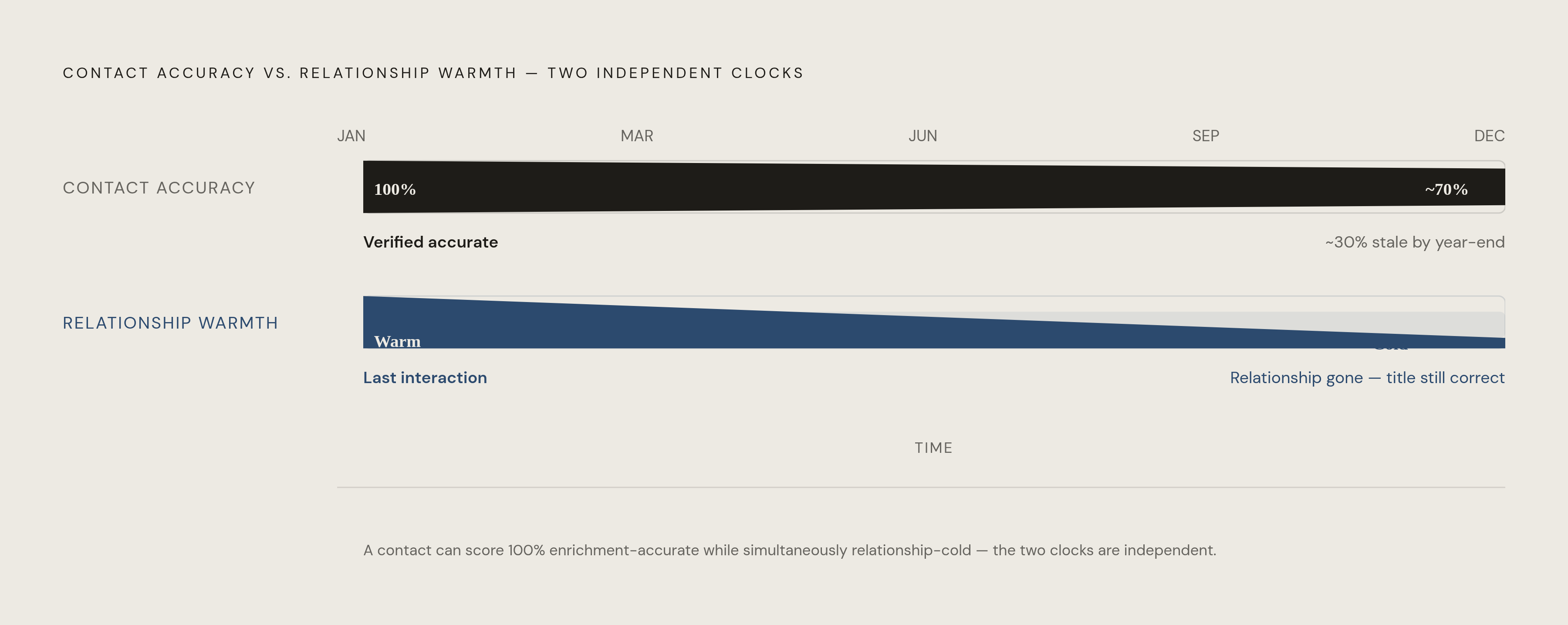
Accuracy in contact enrichment is a function of elapsed time, because professional contact data decays continuously and at a rate that can be measured. B2B contact data decays at roughly 30% per year. A record verified accurate in January carries a meaningful probability of being wrong by midyear, and by December the odds favor at least one stale field somewhere in that record, whether it is a title that no longer applies or a company affiliation that has changed.
That decay rate has a direct consequence for how benchmark figures should be read. A test run on a dataset refreshed within the past few weeks is not comparable to a test run on a static database last updated a year earlier, even when both report the same headline accuracy percentage. The number alone tells you nothing about which side of that gap you are looking at. Asking when a benchmark's underlying data was verified matters as much as asking whether it was verified.
For relationship intelligence work, the consequence of stale data runs deeper than inconvenience. A record that places someone in a role they vacated six months earlier does not just fail to deliver an email. It produces false confidence about who that contact is and whether a path through them is still live, which is a more expensive error than a bounced message. A sales team reroutes a dead lead in a day. A firm that mistakes a stale contact for a warm introduction can lose weeks acting on a connection that no longer exists in the form the data describes.
Email validity, phone reachability, and identity correctness
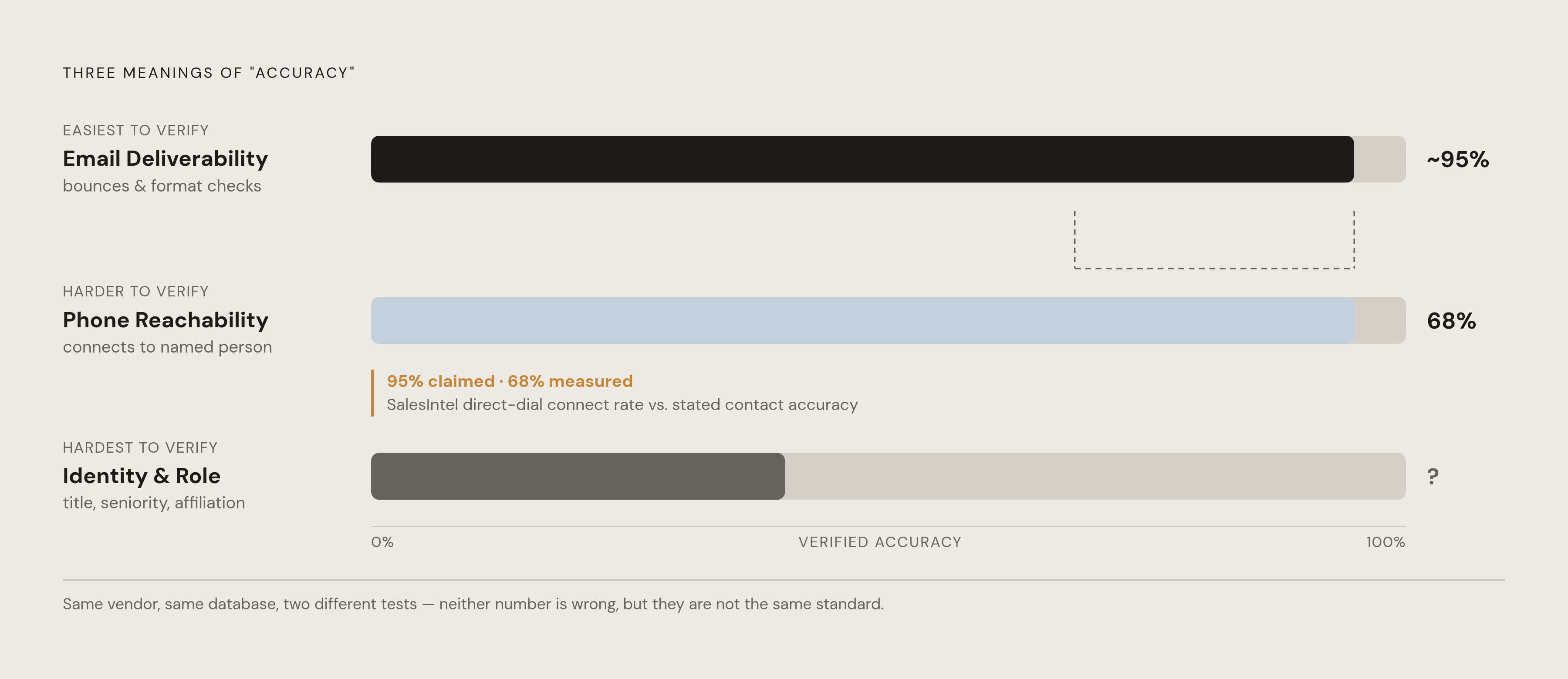
The word "accuracy" in enrichment marketing covers at least three distinct measurements, and treating them as interchangeable produces comparisons that mean nothing. Email deliverability accuracy asks whether a message can be sent without bouncing. Phone reachability accuracy asks whether a number connects to the named person. Identity and role accuracy asks whether the job title, seniority, department, and company affiliation attached to that record are currently correct. Each requires a different verification method, and a vendor's headline figure usually describes only one of them.
Email deliverability is the easiest of the three to verify at scale. That is why it appears most often as the cited number. But a deliverable email says nothing about whether it reaches the intended decision-maker or whether that person's listed role still describes their actual job. SalesIntel's own accuracy documentation draws this distinction explicitly: its cited 95% figure measures contact accuracy, meaning records correctly assigned to the right person, while a separate direct-dial connect rate of 68% found in independent testing measures something else entirely, described on SalesIntel's page as "a different metric: whether someone answers, not whether the number is right." A record can be correctly assigned and still fail to connect. Both numbers are legitimate. Neither substitutes for the other.
Phone reachability sits even further from easy verification. That is why human-verified phone data commands a premium in the market. Cognism positions its Diamond Data specifically around phone-verified mobile numbers, an approach that implicitly concedes that raw database coverage and confirmed reachability are not the same standard. A database can list a mobile number for nearly every contact in its index. Whether that number rings through to the person named is a separate claim, verified by separate means, and phone-verification products are built to close that gap.
Identity and role accuracy is the dimension most relevant to relationship intelligence work, confirming a title or seniority level requires human judgment or cross-source triangulation rather than a simple send-and-check test, which makes it the dimension least often benchmarked with rigor. A tool can report a high email deliverability rate while carrying outdated titles on a meaningful share of its records, and the headline number would never reveal that gap.
A contact enrichment API that returns a field like match_confidence with a high decimal score is making a probabilistic statement about identity correctness, not a binary deliverability claim. That distinction matters for how such a score should be used: a high match_confidence score says a record is very likely correctly matched to the right person, not that it is certainly correct, and treating the two as equivalent erases exactly the uncertainty the score exists to communicate. Teams building on these scores need to decide what confidence threshold a given use case demands, because the cost of a wrong match in a cold outreach campaign is not the same as the cost of a wrong match feeding a warm introduction.
Architecture and the accuracy ceiling
The gap between a high-accuracy enrichment tool and a low-accuracy one is often not a question of which company built it or how large its database is. It is a question of architecture: whether the system queries a single source or sequences a request across many. No single database covers the full professional universe with current data, and that is why waterfall and real-time multi-source architectures exist. They compensate for the blind spots any one source inevitably carries.
A single-source database approach has a structural ceiling built into it. Records that fall outside that database's indexed population return no result at all, and whatever the system does return reflects only that one source's last refresh cycle. Single-source tools typically leave 40-60% of qualified prospects unreachable. Waterfall approaches close a meaningful part of that gap because the architecture routes a query around any single source's coverage holes, checking a second and third source when the first comes back empty or low-confidence.
This is the question an evaluator should ask before comparing two accuracy figures side by side: are both tools using the same architecture? Contact enrichment vendors each approach coverage differently, combining proprietary databases, verification layers, and in some cases waterfall logic across multiple data providers. None of that is a ranking of which is best for a given use case. The architectural choice sitting underneath a headline figure shapes what that figure can possibly mean, and it is an illustration of that fact. A waterfall result and a single-source result reporting similar accuracy percentages are not describing equivalent systems, even when the numbers printed on the page look close enough to compare directly.
The architectural ceiling matters beyond the enrichment tool itself: every downstream system, including relationship intelligence platforms, inherits whatever coverage and accuracy the enrichment layer provides. A relationship graph built on top of contact data that only reaches a fraction of qualified prospects can only ever be as complete as that fraction. The tools discussed in this section are feeding something, and what they feed is the next problem.
The gap between contact enrichment and relationship intelligence, what accuracy benchmarks don't measure
Standard enrichment benchmarks measure whether a record is correct. Relationship intelligence work demands a different and higher standard: whether a connection is current, warm, and traversable, a dimension no published benchmark in the enrichment category currently captures.
Consider what "correct" means in each context. A contact enrichment tool that returns a verified email address and a current job title has done what its benchmark asked of it. But for an investor tracing a path to a fund manager, or a founder trying to reach an OEM partner, the operative question is who, inside the investor's own firm, holds the strongest active relationship with that person right now. Enrichment data cannot answer that question, because the answer does not live in any third-party database. It lives in a firm's own email threads, calendar history, and message logs: the record of who has actually talked to whom, how recently, and how often.
That relationship signal is also subject to its own decay curve, independent of the contact decay discussed earlier. A warm connection from three years ago, with no activity since, can be entirely accurate in the enrichment sense (the person still holds the title the record lists) while being cold in the relationship sense (an introduction routed through that contact will land without context, read by a person who may not remember the relationship at all). Contact accuracy and relationship warmth are two separate measurements, decaying on two separate timelines, and a high score on one says nothing about the other.
This is the layer a relationship intelligence platform is built to address. Rather than enriching contact fields by pulling from external databases, a relationship intelligence platform maps relationship strength and network paths across a team's existing communication history, turning email, calendar, and messaging activity into a queryable record of relationship memory. The output answers a different question than any enrichment benchmark is designed to measure: not just who a contact is, but how warm the path to them currently runs, and who on a given team sits closest to making that introduction. That is additive to the enrichment layer, not a replacement for it. Contact enrichment vendors solve the problem of knowing who someone is and how to reach them directly. Relationship intelligence solves the separate problem of knowing who, inside your own network, should be the one to make that reach happen.
Checklist for trusting an enrichment accuracy claim
Evaluating an enrichment layer that will feed relationship intelligence work calls for a specific set of questions that most vendor comparisons skip. Start with what type of accuracy is actually being claimed. Email deliverability, phone reachability, and identity or role correctness are three different standards, and a vendor should be able to state which one its headline figure describes rather than letting the word "accuracy" do the work of implying all three.
Ask next when the test population was verified and against what standard. A figure built from records refreshed within the past 30 days describes a different reality than one drawn from a static snapshot taken a year earlier, even if the two numbers printed on a page look identical. The decay rate discussed earlier (roughly 30% per year for B2B contact data) means that freshness protocol is close to the whole story.
Press on architecture as well. Was the result produced by a single-source database, a waterfall process across multiple providers, or a real-time multi-source query? The gap between single-source coverage, which typically leaves 40-60% of qualified prospects unreachable, and waterfall coverage is large enough on its own to set the accuracy ceiling before any other factor comes into play, so two tools quoting similar percentages may not be comparable at all once architecture enters the picture.
Where a tool returns confidence scores, ask what they actually represent. A match_confidence figure with a high decimal value is a probabilistic estimate of identity correctness, not a binary guarantee, and a team relying on it should set a defined confidence threshold for high-stakes outreach, treating anything below that threshold with proportionally more caution rather than taking every returned record at face value.
Finally, ask what the enrichment layer does not measure, because that question matters most for relationship work. Relationship warmth, the strength of an introduction path, and how recently two people actually interacted are not enrichment problems. They are relationship intelligence problems, and no enrichment benchmark, however carefully constructed, addresses them. A firm that treats contact accuracy as a stand-in for relationship accuracy will surface exactly the right name, at exactly the right company, with exactly the right title, and still make an introduction that lands cold. Knowing the right name was never the hard part. Knowing the right path to it is.